
The Supreme Court reserved its judgement on a plea regarding insurance coverage for doctors and health workers who died battling Covid-19 in private clinics and non-recognized hospitals. The court emphasized the importance of supporting doctors and ensuring valid claims are settled.
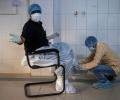
The Union health ministry on Monday announced that all claims of "Covidwarriors" under the Pradhan Mantri Garib Kalyan Package will be settled till April 24 after which a fresh insurance policy for them will become effective.
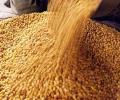
Distributing chana is easier than other varieties of pulses as it only requires cleaning and sorting and can be consumed whole; it was also abundantly available with Nafed.

The finance ministry has asked all ministries and departments not to initiate any new scheme in the current financial year and said that there is a need to use resources prudently in the wake of the COVID-19 crisis. However, funds for schemes under the Pradhan Mantri Garib Kalyan Package, the Aatmanirbhar Bharat Abhiyan package and any other special package or announcement would be allocated, according to an office memorandum by the department of expenditure, which comes under the finance ministry.
The Rs 20 lakh crore package includes Rs 1.7 lakh crore package of free foodgrains to the poor and cash to poor women and elderly, announced in March, as well as the Reserve Bank's liquidity measures and interest rate cuts.

Rs 7,774 crore, has been provisioned for COVID-19 Emergency Response and the rest for medium-term support, ranging from one to four years to be provided under mission-mode approach.
Chana is majorly imported from Australia and Tanzania and it attracts an import duty of 60 per cent. A section of the traders is demanding a reduction in import duty to around 35-40 per cent to tide over any shortage of the commodity as the new crop will start hitting the market only around mid-February.

The approval is in addition to the existing scheme for the wage months of March to May, 2020 approved on April 15, 2020. The total estimated expenditure is Rs 4,860 crore and over 72 lakh employees in 3.67 lakh establishments will be benefitted.
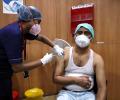
This was stated by Minister of State for Health Ashwini Kumar Choubey in the House in response to a question on the number of healthcare staff, including doctors, nurses and ASHA workers who have been affected died due to COVID-19.

The finance minister has emphasised on the quick disbursal of additional loans to MSMEs, to simplify process, formats and documentation.

also made a case for the need to create a self-sufficiency fund for innovation, construction and manufacturing clusters to make use of the emerging opportunities in the wake of disruption in global supply chain.

The plan could mature into either an umbrella programme for urban youths similar to the Garib Kalyan Rozgaar Abhiyaan or a modified urban-focused version of MGNREGS.

The number of active COVID-19 cases stands at 9,272 and as many as 1,189 people have been cured and discharged, and one has migrated, it said.
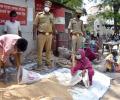
A recent study shows that more than 100 million people are excluded from the public distribution system because the central government insists on using 2011 population figures to calculate state-wise PDS coverage, which effectively leaves out 100 million people, reports Sanjeeb Mukherjee.
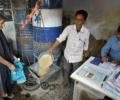
A study by eminent economists, by Jean Drze, Reetika Khera and Meghana Mungikar released few days back shows that more than 100 million people are excluded from the PDS because the central government insists on using 2011 population figures to calculate state-wise coverage under the National Food Security Act.

These dedicated COVID-19 facilities will have a capacity of 1,06,719 isolation beds and 12,024 ICU beds reserved for such patients in the country.

To help revive the economy battered by COVID-19, Finance Minister Nirmala Sitharaman on Monday announced a slew of measures, including Rs 1.1 lakh crore credit guarantee scheme for improving health infrastructure, and enhancing the limit under the ECLGS by 50 per cent to Rs 4.5 lakh crore for the MSME sector facing liquidity crunch. Sharing the details of stimulus package, the finance minister said this comprises eight relief measures and other eight measures to support the economic growth. She announced Rs 1.1 lakh crore loan guarantee scheme for COVID-affected sectors, including health sector, which includes guarantee cover for expansion or for new projects. Besides, she said, additional Rs 1.5 lakh crore limit enhancement done for Emergency Credit Line Guarantee Scheme (ECLGS) scheme.

The vaccination drive was only one important part of India's globally recognised pandemic management and response strategy, observes Dr Vinod K Paul.

Finance Minister Nirmala Sitharama on Thursday stated the government is planning to provide a relief package of Rs 1.7 lakh crore to the underprivileged, poor and migrant workers affected by the lockdown amid the coronavirus outbreak. The scheme has been named the Pradhan Mantri Garib Kalyan Scheme.
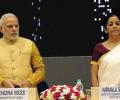
Prime Minister Narendra Modi on Thursday reviewed the impact of Covid-19 on the Indian economy and a possible second stimulus to boost sectors hit hard by the pandemic. Modi held discussions with Finance Minister Nirmala Sitharaman as the pandemic hit sectors from small industries to the aviation sector hard with millions of jobs at stake.
On the extension of the PMGKAY, he said it will cost the government Rs 90,000 crore more.

The government has only taken a pause and more measures will be announced in the days to come to help sectors hit by the coronavirus outbreak and also to make India 'Atmanirbhar Bharat', Minister of State for Finance Anurag Thakur said. Since the outbreak of the pandemic, the government has taken several steps to mitigate the hardships of the people due to lockdown and support growth, Thakur told PTI in an interview.
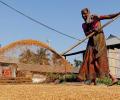
Stating that the food subsidy bill is becoming "unmanageably large", the Economic Survey 2021 on Friday suggested the government to increase the selling price of foodgrains provided through ration shops to over 80 crore beneficiaries. Foodgrains via ration shops are supplied at highly subsidised rates of Rs 3 per kg for rice, Rs 2 per kg for wheat and Rs 1 per kg for coarse grains through Public Distribution System (PDS) as per the National Food Security Act (NFSA). "While it is difficult to reduce the economic cost of food management in view of rising commitment towards food security, there is a need to consider the revision of central issue price (CIP) to reduce the bulging food subsidy bill," the survey said.
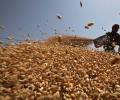
To ensure enough food to the poor during the lockdown, the government last week started distributing free 5 kg of rice or wheat per person and 1 kg pulse per household under the Pradhan Mantri Garib Kalyan Yojana to over 81 crore PDS beneficiaries.
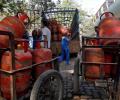
The relaxation would be available only to those beneficiaries who have been credited with the advance for buying the cylinder but have not been able to purchase the refill.

This includes an infrastructure push which may lead to the government spending more than its budgeted capital expenditure for 2020-21. There are also discussions on increasing the scope and quantum of direct cash transfers to the beneficiaries who need it the most.

The districts are Gondia (Maharashtra), Raj Nand Gaon (Chhattisgarh), Davangiri (Karnataka), South Goa, Wayanad and Kottayam (Kerala), West Imphal (Manipur), Rajouri (J&K), Aizwal West (Mizoram), Mahe in Puducherry, SBS Nagar in Punjab, Patna, Nalanda and Munger in Bihar, Pratapgarh in Rajasthan, Panipat, Rohtak and Sirsa in Haryana, Pauri Garhwal in Uttrakhand and Bhadradari Kothagudem in Telangana.
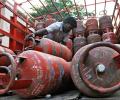
Given that the target was to reach 80.34 million families under PMUY - within three months starting April 1 - the government should have distributed at least 241.02 million cylinders by the end of June. It actually ended up distributing only 119.7 million cylinders.

This is the full text of the address to the nation by President Droupadi Murmu on the eve of India's 78th Independence Day.

Gadkari said, infrastructure sector including highways, airports, inland waterways, railways, logistic parks, broad gauge and metro, apart from MSMEs can attract large scale foreign investment.

It also opposed the suggestion that the contributions be transferred to the National Disaster Response Fund.

With the world's worst outbreak of COVID pandemic stalling a nascent economic recovery, the government has begun assessing the impact of the second wave of infections on different sectors and may look at providing support at an appropriate time to segments requiring fiscal help. Some of the economic indicators, including the Goods and Services Tax (GST) collections, still provide confidence and incoming data will throw some more light on the state of the economy, sources said. Services sectors like hospitality, tourism and aviation which had just started recovering were hit hard by the second wave of COVID, the sources said, adding these segments might need some support on an urgent basis from the government.

They say that a stimulus package may not be necessary because, unlike last year's total lockdown, public transport, including the railways and airlines, is running and the restrictions on movement are localised and, in some cases, are partial rather than total.

Fitch Ratings director Thomas Rookmaaker said India's debt-to-GDP ratio is likely to rise to 76 per cent from 70 per cent currently due to wider fiscal deficit and low economic growth.

'Everyone wants that doctors should fight from the frontlines of the pandemic, but there's no reaction from the government when they fall ill or even die because of it.'

'Like doctors, health workers, police, bankers are also COVID warriors,' notes Tamal Bandyopadhyay.
Whether it was the MGNREGS or the NFSA or the Aadhaar-based DBT scheme for cash transfer, the Modi government has built on the basic architecture created by the Singh government. Policy makers in the Modi government, instead of discarding them as products of the previous political regime, worked on them, expanded their scope and reach, and used new tools to improve their performance, explains A K Bhattacharya.
This will cost the government Rs 3.1 trillion, about 10 per cent of its annual expenditure, and higher than any other spending item in its Budget.

Apart from Bihar, Chhattisgarh and Jharkhand, where none of the estimated 6.7 million construction workers got cash transfer benefits, the coverage of the construction workers was the lowest in Delhi, where only about 5 per cent of the estimated workers received cash under the PMGKY, followed by Kerala and Uttar Pradesh (22 per cent), among major states. In India, construction workers belong to the unorganised sector but account for the highest share of non-farm jobs after manufacturing.
'The stimulus message was tagged on to what was meant to be an exhortation to self-reliance, glossing over the near impossibility of merging the immediate requirement of relief for a huge population and a questionable strategy for the future trajectory of a large economy aspiring to superstardom,' points out Shreekant Sambrani.
